


Street research / Employee liquidity
Stripe’s liquidity playbook.
From a financing for employee liquidity and taxes to three consecutive years of tenders. A closer look at the capital, the tradeoffs, and the effects we can actually observe.
Figure 01 / Valuation
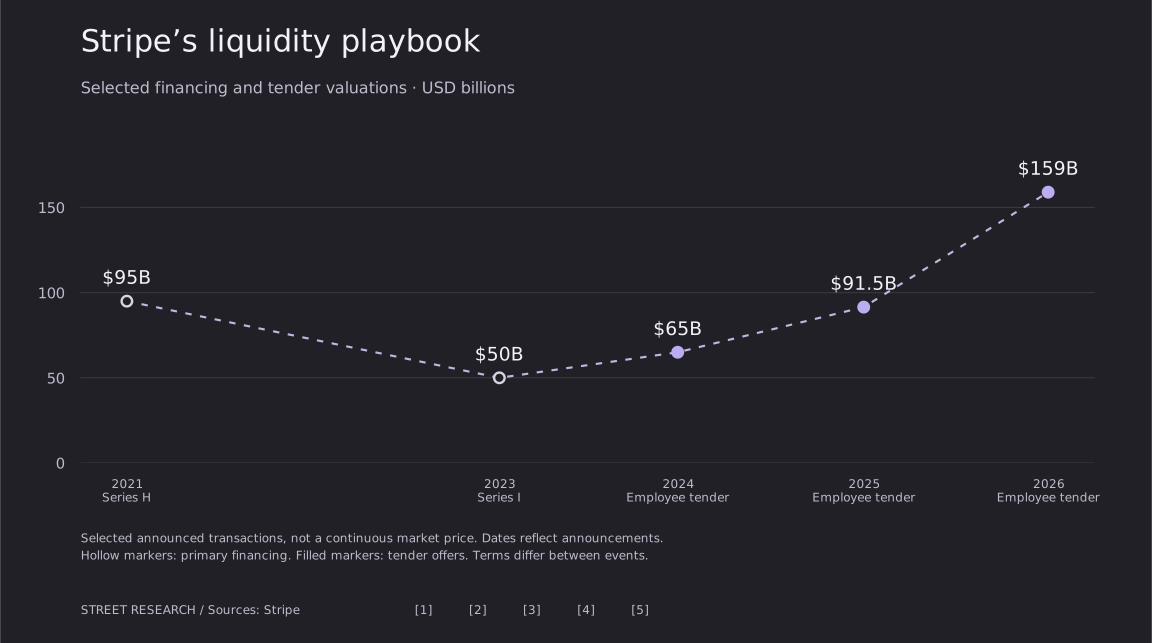
A reset. Then a series of higher marks.
Announced company valuation · USD billions
Thrive Capital, Coatue, a16z and other investors would provide most of the funding, alongside Stripe repurchases. Agreements were announced at a $159 billion valuation. Stripe announcement ↗
Employee liquidity became a recurring decision.
Stripe’s case is about giving different shareholders different timelines. Employees could be offered a route to cash while the company continued operating privately.
The important change was the mechanism. A large financing in 2023 addressed liquidity and equity-related taxes; tender announcements followed in February 2024, 2025 and 2026. Each later offer included current and former employees, with both outside investors and Stripe participating as buyers. [2][3][4][5]
A defined opportunity to sell, with eligibility and terms set for each window.
A way to address shareholder needs separately from the decision to list publicly.
Ownership transfers and company repurchases, with different effects on outstanding shares.
These are structural implications of the announced programs. The public releases do not establish how much individual employees received or whether the offers improved retention.
The transaction record, year by year.
The headline valuation describes the company. The financing amount describes capital raised. The tender size describes shares offered for purchase. Keeping those measures separate is essential to understanding this case.
| Event | Valuation | Funding and purpose |
|---|---|---|
| 15 Mar 2023Series I | $50B | More than $6.5B in new financing. Employee liquidity and withholding obligations; planned share retirements would offset new investor issuance. [2] |
| 28 Feb 2024Employee tender | $65B | Mostly investor-funded. Stripe also committed its own capital, explicitly linking repurchases to compensation dilution. [3] |
| 27 Feb 2025Employee tender | $91.5B | Investors and Stripe buying. The release did not disclose a total offer size or the split between buyers. [4] |
| 24 Feb 2026Employee tender | $159B | Mostly investor-funded. Thrive Capital, Coatue and a16z were named, alongside other investors and Stripe’s own repurchases. [5] |
Scroll the table to see every column
The three tender releases describe signed agreements, not a published reconciliation of completed employee payouts. None states the aggregate tender size. The Series I amount should not be presented as employees’ net cash proceeds.
What changed for employees.
A way to turn a holding into a financial choice.
A private equity award can be valuable without being spendable. An arranged sale creates a concrete decision: accept the terms for an eligible holding, or continue carrying the exposure. A partial sale can reduce an employee’s dependence on one company while preserving some participation in its future. That is the economic mechanism; the announcements do not reveal individual sale limits or take-up.
Liquidity also reached people who had left.
Former employees were explicitly included in all three tender announcements. This matters when interpreting the purpose: access was not described solely as a benefit for people still on payroll. It also addressed ownership accumulated during earlier employment. [3][4][5]
The first financing addressed a tax-related constraint.
Stripe’s 2023 announcement earmarked financing for withholding obligations associated with equity awards, as well as employee liquidity. It did not publish the allocation between those uses. A gross financing figure cannot tell us how much spendable cash employees retained after taxes. [2]
Three capital movements, three different effects.
A tender with outside buyers is different from a company-funded repurchase. The former transfers existing ownership; the latter also uses the company’s balance sheet. New share issuance is a third activity. Stripe’s announcements describe combinations of these, rather than one universal structure. [2][3][5]
Figure 02 / Funding mechanics
Follow the capital. Then the shares.
The financing choice determines who carries the cost. A direct purchase by an investor does not itself create new shares. A company buyback consumes corporate cash. Issuing shares can fund liquidity but introduces a dilution question. A board needs both a cash budget and a share-count reconciliation to assess the combined effect.
Axios reported an $861M purchase of Stripe shares from Sequoia limited partners, completed in September 2024. [10]
This separate investor transaction is excluded from the employee-tender series above. It illustrates why an employee program and liquidity for a fund’s investors should be examined separately.
More liquidity did not remove valuation risk.
The earlier reference was a $95B financing in March 2021. The March 2023 round marked a substantial reset; the subsequent tender valuations rose. An employee offered liquidity at one point in this sequence faced a different economic choice from an employee offered it at another. [1][2][3][4][5]
- 2021 financing → 2023 financing
- -47.4%
- 2024 tender → 2026 tender
- +144.6%
Change in announced company valuation
Change in announced company valuation
Street calculations: (50 ÷ 95 − 1) × 100 and (159 ÷ 65 − 1) × 100. These compare headline valuations, not the return on an employee’s award.
Employee economics require the share price, share count, security terms, acquisition or exercise cost, tax treatment and actual allocation. The disclosed valuations alone do not supply that bridge. They are useful transaction reference points, but cannot establish an employee’s realized gain or mark every outstanding security on identical terms.
Recurring opportunities can make the timing decision less binary. They do not remove the possibility of selling before a rise, holding through a fall, or receiving a smaller allocation than desired. Nor do past windows create an entitlement to the next one.
The operating backdrop mattered.
Stripe reported positive cash flow for 2023, profitability in 2024 and continued profitability in 2025. These disclosures help explain its capacity to combine investment in the business with purchases of its own shares. They do not show that tenders caused the business to grow. [7][8][9]
Figure 03 / Operating context
The business kept expanding.
Annual volume · USD trillions
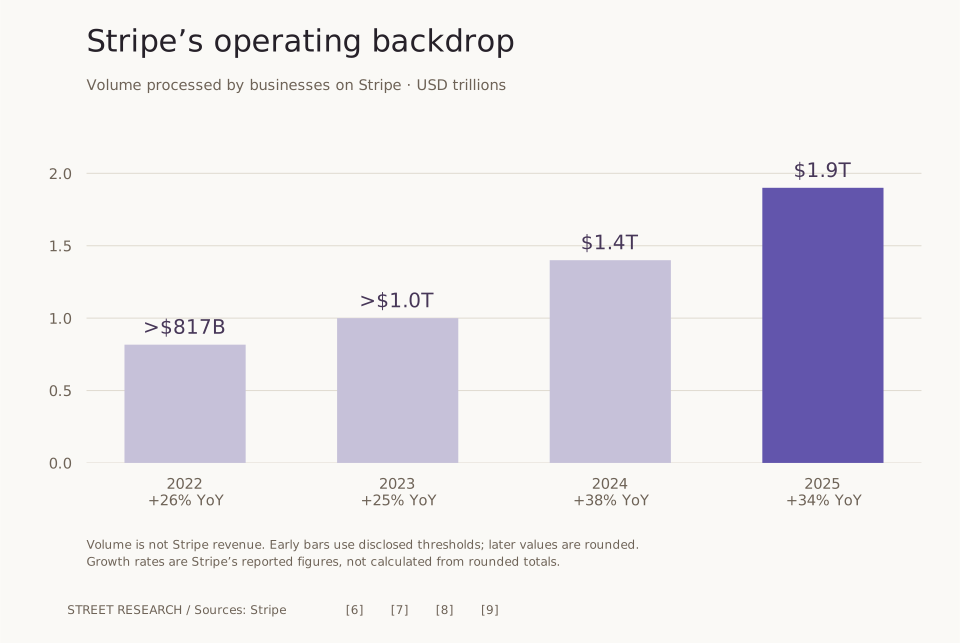
Scale and access to capital are part of the explanation. The 2026 offer paired company capital with investors willing to buy at the new valuation. A smaller business with limited cash or uncertain buyer demand cannot assume the same program is available on the same terms. [5]
The more defensible inference is that operating strength and outside demand supported the liquidity options. Public data does not isolate how much those options affected growth, nor how long they changed Stripe’s IPO timetable.
Design around the decision you want to enable.
For another founder, the transferable lesson is a program design discipline. Before announcing a window, make the employee decision, buyer commitment and company exposure legible.
Define whose liquidity problem you are solving.
Current employees, former employees and financial investors may have different needs. Specify eligible holdings, sale limits and how demand will be allocated.
Separate the funding budget from the valuation.
Set out who will buy, how much capital is committed and what cash the company will use. A large valuation cannot substitute for an executable purchase commitment.
Measure the effect after the window.
Track participation, requested versus completed sales, employee proceeds and changes in outstanding shares. Assess talent outcomes over time before crediting liquidity with a retention improvement.
Stripe shows how liquidity can become a repeated part of private ownership. Its public record is strongest on the structure and recurrence of that opportunity. The evidence for its effect on employee behavior remains much thinner.
Sources & methodology.
Reviewed September 13, 2026. This case reconstructs selected financing and employee-liquidity announcements through February 24, 2026, with 2021 financing context and operating data through 2025. It is not a complete record of every private Stripe share transaction.
Figures reproduce Stripe’s announced values and reporting periods. The valuation chart uses announcement dates; it does not mix in 409A marks or broker indications. The volume chart preserves published rounding and growth rates. Company-reported objectives are distinguished from completed or independently measured outcomes.
- 01Series H financing announcement ↗Stripe · March 14, 2021
$600M financing and $95B valuation; expansion use of proceeds.
- 02Series I financing and employee liquidity ↗Stripe · March 15, 2023
More than $6.5B at $50B; liquidity, withholding taxes and planned share retirement.
- 032024 employee tender announcement ↗Stripe · February 28, 2024
$65B valuation, employee eligibility, investor funding and the dilution-offset objective.
- 042025 employee tender announcement ↗Stripe · February 27, 2025
$91.5B valuation; investor purchases and company repurchases.
- 052026 employee tender and annual update ↗Stripe · February 24, 2026
$159B valuation; named investors, funding mix and announced participants.
- 06
- 072023 annual letter, page 1 ↗Stripe · March 13, 2024
The $1T volume milestone, 25% growth and positive cash flow.
- 082024 annual letter, page 1 ↗Stripe · February 27, 2025
$1.4T payment volume, 38% growth and reported profitability.
- 092025 annual letter, page 1 ↗Stripe · February 24, 2026
$1.9T total volume, 34% growth and continued profitability.
- 10
Independent research based on public material. Street did not participate in these transactions; no relationship with or endorsement by Stripe is implied.