


Street research / Employee liquidity
Clay’s liquidity playbook.
Two employee tenders during a period of rapid growth. A closer look at who could sell, who supplied the capital, and the evidence behind Clay’s investment in its team.
Figure 01 / Valuation
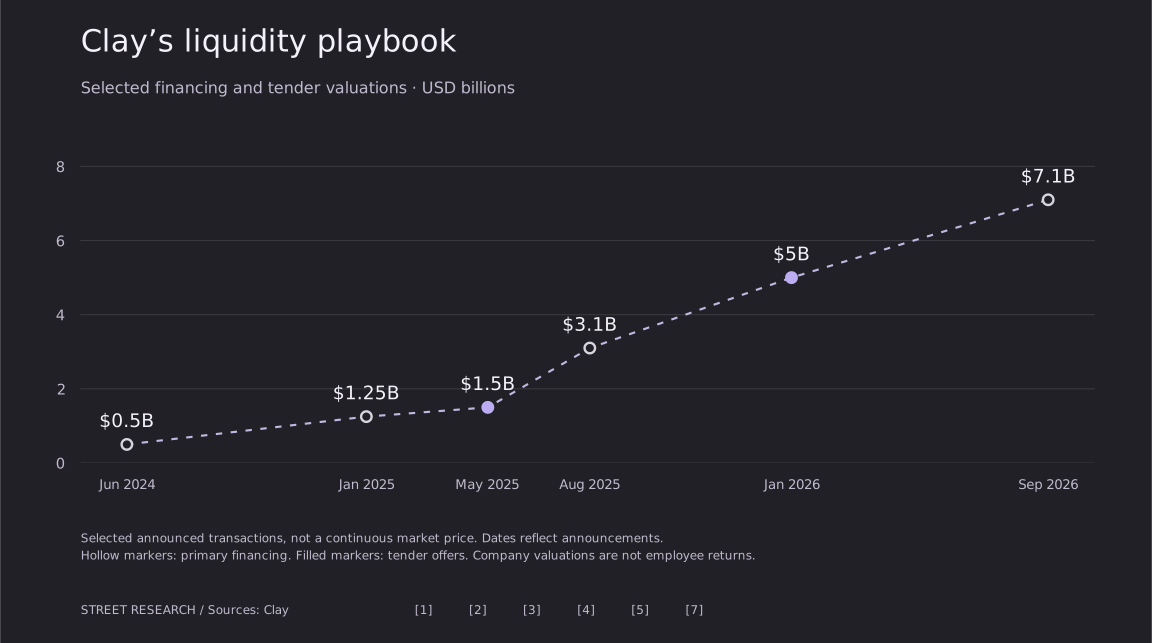
Two liquidity windows amid a rapid climb.
Announced company valuation · USD billions
Wellington led a $115M Series D. This later financing provides context; it is not a third employee tender. Clay announcement ↗
A growing company. A second timeline for its people.
Clay offered employees a way to realize part of their equity while continuing to build the business. Its case brings the liquidity decision into an earlier stage of private-company growth.
The first tender was announced in May 2025; a second followed 265 days later. Company financings continued around those windows. Together, these events show two distinct uses of investor capital: funding the business and buying stock from its people. [2][3][4][5][7]
A partial sale could make accumulated equity usable before a company-wide exit.
A chance to address personal financial needs while maintaining a long-term ownership incentive.
A route into existing employee-held stock, separate from subscribing for newly issued shares.
These are the economic mechanisms of the offers. The public record is less complete on participation, employee proceeds and changes in employee behavior.
Six events. Two employee liquidity windows.
The valuation series combines primary financings and tenders. The destination of the money is different in each. Even the two tender amounts have different definitions: the first is one buyer’s initial commitment; the second is an offer ceiling.
| Event | Valuation | Funding and purpose |
|---|---|---|
| 27 Jun 2024Series B | $500M | $46M of primary financing. The $62M headline also included a previously unannounced $13.5M Series A and $2.5M seed round. [1] |
| 22 Jan 2025Series B extension | $1.25B | $40M led by Meritech. Additional company financing; Clay said the preceding round remained untouched. [2] |
| 8 May 2025First tender | $1.5B | Sequoia committed the first $20M. Clay would also participate. The announcement did not state the total tender size. [3] |
| 5 Aug 2025Series C | $3.1B | $100M of primary financing. Capital for the company, distinct from purchases of employee stock. [4] |
| 28 Jan 2026Second tender | $5B | Up to $55M in employee shares. DST Global led the buyer group. This was an offer limit, not a disclosure of completed payouts. [5] |
| 9 Sep 2026Series D | $7.1B | $115M led by Wellington. The latest financing supplies valuation context; it was not a third employee tender. [7] |
Scroll the table to see every column
Adding $20M and $55M would not establish total employee liquidity. Nor do those figures support a like-for-like tender-size growth rate. Download the tender terms ↓
What changed for employees.
Some wealth could become usable before an exit.
An employee can have both their income and a substantial share of their wealth tied to one company. A partial sale changes that exposure: some value can move into cash, while the unsold holding remains at risk and retains its potential upside. The practical benefit is a choice about concentration and personal timing.
Vesting and eligibility still determined access.
The May offer covered employees with vested shares and former team members holding stock. Clay described the opportunity in terms of financial flexibility, including major personal purchases and projects. That is broader than a reward reserved for people still on payroll. The January announcement discussed vested equity, but did not separately restate former-employee eligibility. [3][5]
The retention argument needs careful interpretation.
Clay’s founders reported that liquidity had supported commitment and longer stays. [5] Their account is relevant evidence of management’s experience. It does not isolate the effect of the tender from compensation, company performance, hiring mix or the value of remaining equity.
Who bought the shares matters.
External buyers can fund employee liquidity without the company supplying the entire purchase price. Company participation adds a separate cash decision. Clay’s first announcement explicitly combined these sources; the second identified a new investor-led buyer group. [3][5]
Figure 02 / Funding mechanics
The capital behind the opportunity.
A direct investor purchase of an existing share changes its owner; it does not itself issue a new share. A company purchase uses corporate funds and can affect the outstanding share count depending on its treatment. The announcements do not supply enough detail to calculate Clay’s net dilution or share retirement.
The Series B, extension, Series C and Series D belong in the company-financing record. Their proceeds should not be counted as cash delivered to employee sellers. [1][2][4][7]
The consequence for another founder is concrete: securing a valuation and securing a buyer budget are different tasks. A program needs committed capital, allocation rules and settlement terms before an employee can turn the opportunity into a completed sale.
A higher mark changed the choice.
The two tenders were announced at company valuations of $1.5B and $5B. The interval was short, but the change in the reference valuation was substantial. That makes the timing of each opportunity central to the employee decision. [3][5]
- First tender → second tender
- +233.3%
- Between tender announcements
- 265 days
Change in announced company valuation
8 May 2025 → 28 January 2026
Street calculations: (5 ÷ 1.5 − 1) × 100; calendar days between announcement dates. The valuation comparison is not an employee investment return or a per-share price comparison.
Award economics depend on the security, share count, exercise or acquisition cost, taxes and the amount actually sold. A higher headline valuation does not resolve those inputs. A seller also gives up exposure on the shares sold; a holder continues to bear concentration and valuation risk.
The subsequent $7.1B Series D is useful context for that tradeoff. It is neither proof that every employee could transact at that mark nor evidence of another liquidity window. [7] Two past offers also do not promise a fixed cadence or future access.
Growth made the setting unusual.
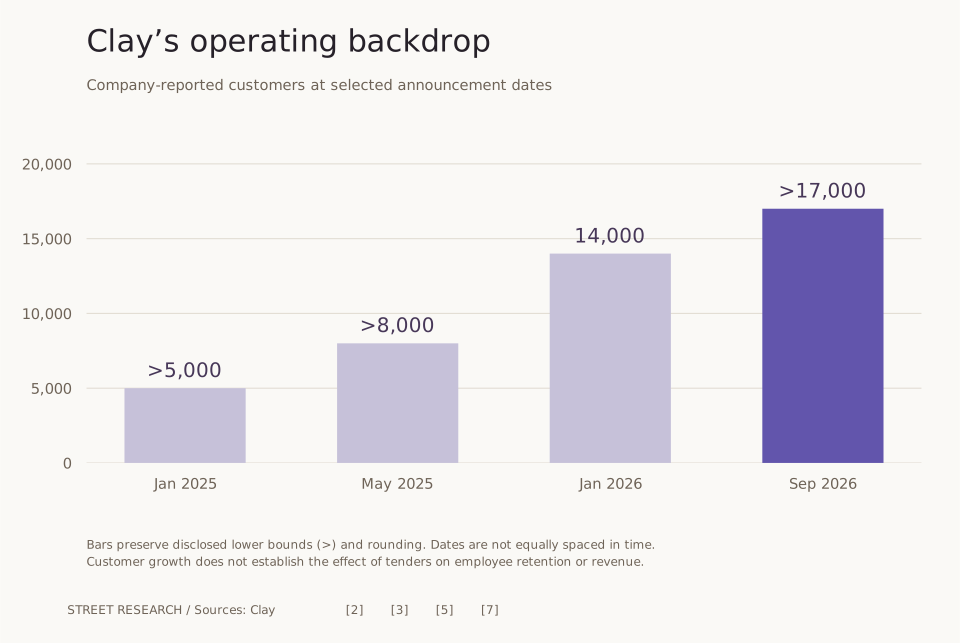
Clay’s customer base expanded across the period. The chart uses dated company announcements so each count can be traced to a specific disclosure. It does not treat those snapshots as evenly spaced annual observations.
Figure 03 / Operating context
A growing customer base.
Company-reported customers
Commercial momentum and employee retention are different measures.
In December 2025, Clay announced that it had crossed $100M in annual recurring revenue, rising from $1M in roughly two years. It also reported enterprise net revenue retention above 200%. ARR is a recurring revenue run rate, not recognized annual revenue; net revenue retention describes customer spending, not employees staying. [6]
The company’s January 2025 statement that earlier financing was still untouched provides another piece of context. [2] Strong fundraising access and business momentum can make a liquidity program easier to support. They also make Clay an imperfect comparison for a company with limited runway or weak secondary demand.
The direction of causality remains unresolved. Growth may attract buyers and support higher valuations; liquidity may improve the employee experience. Public announcements do not identify how much the latter contributed to the former.
Build the program around a specific employee choice.
Clay’s example is useful because it makes employee liquidity an explicit company decision during growth. The transferable work lies in designing and measuring that decision.
Make eligibility and the retained stake explicit.
State who can participate, which vested holdings qualify, and how much may be sold. Explain the exposure that remains after a partial sale so employees can assess the whole decision.
Match the offer to an executable budget.
Distinguish a buyer’s commitment, the total offer ceiling and completed purchases. Decide how much company cash, if any, belongs in the program. Plan for oversubscription before the window opens.
Measure the employee outcome separately from growth.
Record requested and completed sales, participation and proceeds. Follow retention over time while accounting for vesting, tenure and company performance. Customer growth is not a substitute for that evidence.
Clay demonstrates a deliberate attempt to make private equity more useful to employees. The two offers are documented. The size of their effect on employee retention is still an open research question.
Sources & methodology.
Reviewed September 13, 2026. This case covers selected Clay financing and employee-tender announcements from June 27, 2024 through September 9, 2026. All seven sources below are company publications; the reported figures have not been independently audited for this article.
Valuations use announcement dates and nominal US dollars. Financing, purchase commitments and offer limits remain distinct. Customer bars preserve lower bounds and rounding from dated announcements; changes in customer definitions have not been independently reconciled. No causal estimate of hiring, retention or growth is inferred from the transaction timeline.
- 01Series B and earlier financing announcements ↗Clay · June 27, 2024
$46M Series B at $500M; the $62M headline includes earlier rounds.
- 02Series B expansion ↗Clay · January 22, 2025
$40M at $1.25B; more than 5,000 customers and prior funding remaining untouched.
- 03First employee tender ↗Clay · May 8, 2025
Eligibility, Sequoia’s initial commitment, Clay’s participation and customer count.
- 04
- 05Second employee tender ↗Clay · January 28, 2026
Offer cap, valuation, buyer group, customer count and founders’ talent thesis.
- 06The $100M ARR milestone ↗Clay · December 8, 2025
ARR growth and enterprise customer retention, distinct from employee retention.
- 07Series D announcement ↗Clay · September 9, 2026
$115M at $7.1B, led by Wellington; more than 17,000 customers.
Independent research based on public material. Street did not participate in these transactions; no relationship with or endorsement by Clay is implied.