
06
Every Market Begins in the Street
The most valuable companies of our era are private, and the market for their shares has already formed without them.
A company's market should be formed with the company. We are building the exchange where that happens.
06
Markets form wherever value meets demand, whether or not anyone gives permission.
Introduction
If you work at a company people want a piece of, you have already received the message. It arrives on LinkedIn, from someone you have never met, with a title like Director of Private Markets at a firm you have never heard of. It says they are working with buyers for shares of your company. It quotes a price, usually a premium to the last round and sometimes a number your own finance team has never seen, and asks whether you would be open to a confidential, no-obligation conversation about liquidity for your vested equity. Your colleagues got the same message, at a slightly different price. Nobody at your company sent it. Nobody at your company can tell you whether the number is real. And if you ask, the answer is that any transfer requires board approval, which answers a question about permission and says nothing about price.
That message is the market forming. It has a bid, a spread and a sales force; the bid is usually an inquiry about supply dressed up as an offer, to be shopped to buyers or wrapped into a vehicle once the seller says yes. The only party not in the room is the company. Founders usually find out when an employee forwards the message, or when the number in it becomes the price everyone quotes. The most closely watched private company in the world found out from the news.
The conference room
GPT Image 2
On a Monday at the end of June 2025, at a presentation in Cannes, Robinhood announced a giveaway of “OpenAI tokens” and “SpaceX tokens” to retail investors across the European Union, the opening move in a plan to sell tokenized private companies to the public.  OpenAI learned of it when everyone else did. Its reply, posted two days later from the company's newsroom account, is as close as a corporate statement gets to a shout: “These ‘OpenAI tokens’ are not OpenAI equity. We did not partner with Robinhood, were not involved in this, and do not endorse it.” Robinhood's chief executive did not dispute a word of it. The tokens, he agreed, “aren't technically equity,” but they “effectively give retail exposure to these private assets.” Then he added the detail that deserved more attention than the dispute: since the announcement, “we've been hearing from many private companies that are eager to join us.”
Both were right, and that is the problem. OpenAI had acquired a public price, a number that moved by the hour, on a venue the company had not chosen, for an instrument it had not issued. Until then its value had been set once every eighteen months or so, in a conference room, by people it had chosen. The market for OpenAI had formed. OpenAI was the last to know.
It did not stop there. By May of 2026, OpenAI and  Anthropic had both rewritten their transfer policies to declare any unauthorized sale of their shares void, whether direct, through a special-purpose vehicle, tokenized, or by forward contract. Void in the legal sense: a sale the company will treat as never having happened. “The sale will not be recognized,” OpenAI's policy now reads, “and carry no economic value to you.” Anthropic went further and published a list of eight venues whose transactions it would not honor, among them some of the largest names in the industry. A token tracking Anthropic fell from $1,400 to $900 within a day. A month later
  SpaceX went public, and investors who had bought in through vehicles stacked four and five layers deep learned that they would not know how many shares they owned, or whether they owned any, for months, and in the bottom layers most of a year.
This is the state of the market for the most valuable companies of our era. A prediction market will quote you odds on when OpenAI lists and what it will be worth at the close of its first day, refreshed by the minute; nobody, including OpenAI, can quote you a price for OpenAI today. On a single day in February 2025, the same share of  Cerebras was quoted at $13 on one venue and $57 on another. A bond trader from 2001, the last time a major market worked like this, would recognize every part of it: the phone calls, the spread, the middlemen whose entire business is knowing something you don't.
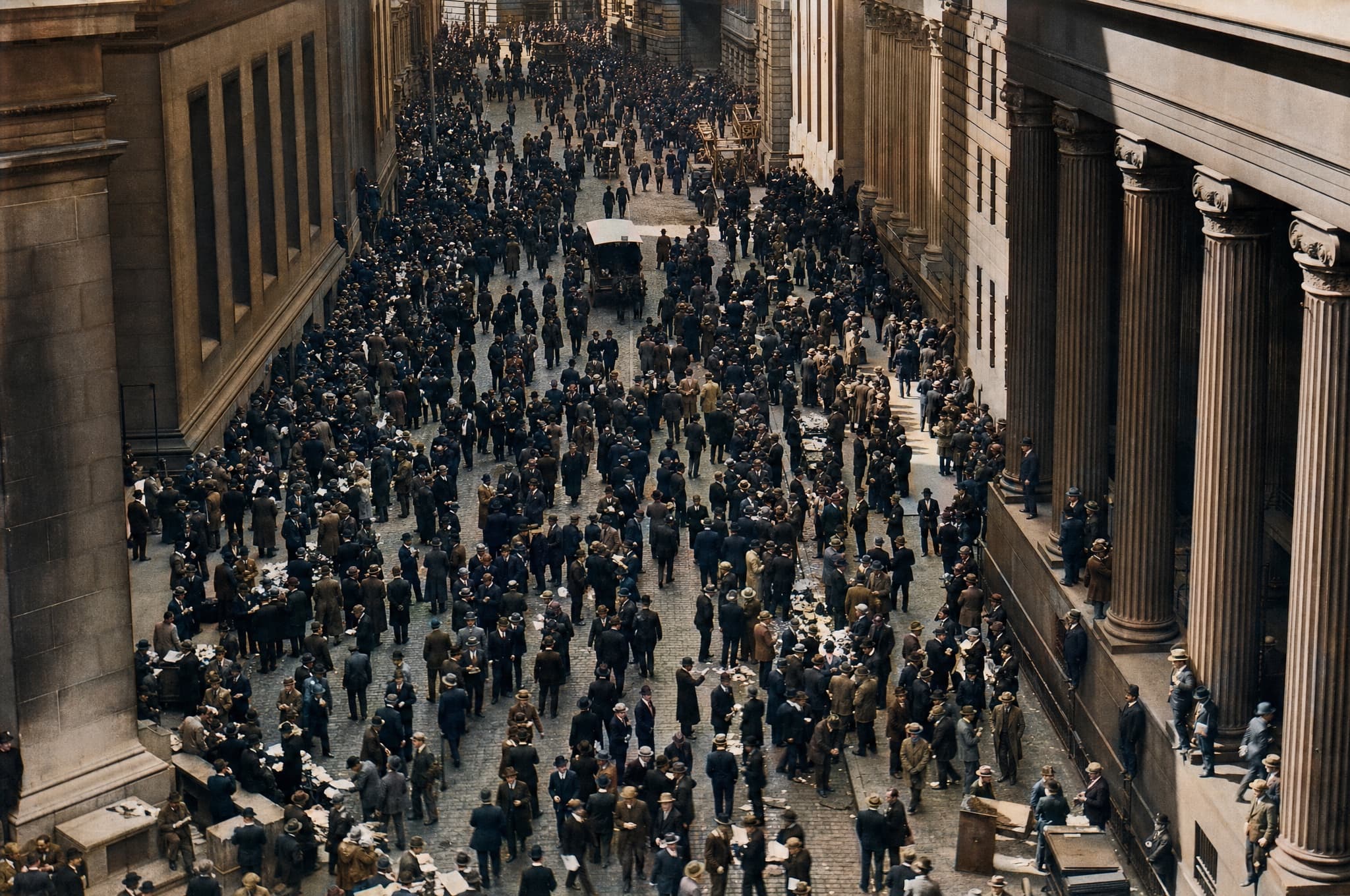
It was not always so. For most of the twentieth century a company that mattered had a price, and the price was a fact, printed in the morning paper, the same for everyone. Coca-Cola, General Motors and Standard Oil were quoted daily on a New York sidewalk before the Stock Exchange would have them, and on the Big Board after. A company grew up in public, and its price, set by thousands of strangers who disagreed with one another, was the most honest thing about it. The exchange is one of the great inventions of civilization. It turned ownership into something that could be measured, divided and moved, and in doing so it built the modern economy. And over the last thirty years we have quietly stopped using it for the companies that matter most. In 1996 there were more than 8,000 listed companies in the United States; today there are about 4,700. The average unicorn now spends nine years private before it lists, if it lists at all; more than 1,200 of them are waiting. The entire growth phase of this era's defining companies, the years in which nearly all of the value is created, now takes place inside a legal structure that was never designed to host a market, and that is hosting one anyway.
The brokers, the platforms and the vehicle sponsors who work inside that structure are doing difficult, mostly honest work in a market with no rails, and much of what they charge is the price of that work: finding a seller, finding a buyer, papering a transfer, waiting out a right of first refusal. But look at where the margin comes from. It is the spread: the distance between what the seller received and what the buyer paid, and the layers in between. A market with one price and one layer would erase it. History is unambiguous about what intermediaries do with that incentive. When they have built venues, they have built them to protect the spread: the Buttonwood Agreement of 1792, the founding document of the New York Stock Exchange, was a promise among twenty-four brokers to fix their commissions and deal only with each other, and the fixed commission survived until the government abolished it in 1975, over the objections of an exchange whose chairman warned that competition would “freeze the public out of the securities markets.” When regulators began publishing corporate-bond trades in 2002, the dealers warned that transparency would come at the cost of liquidity. Investors' trading costs fell by roughly half; the dealers' margins, headcount and market share fell with them. The public exchanges will not build this either; they were built for the disclosure regime of a mature company, and a company at its Series B cannot live under it. A market formed with the company has no infrastructure yet. It has to be built, and it will not be built by the people the spread pays.
The exchange has always worked this way, with the company. A company arrives on the New York Stock Exchange by applying: it files a registration statement, signs a listing agreement, and discloses on the exchange's schedule, and in return its shares trade in one place, at one price, in front of everyone. The venue brings the rules and the price; the company brings its consent and the facts. The private market of 2026 has exactly half of that arrangement. The company's consent has become decisive, as the void clauses and the collapse of the Anthropic token showed, and there is still no venue for the company to bring it to.
One platform will not be enough for this. Every company of consequence will eventually list somewhere long before it goes public, on terms it helped set, and that will require standards, infrastructure, and a generation of engineers who might otherwise spend their careers shaving microseconds off the public market's plumbing. When the over-the-counter market got its first screen in February 1971, the system was built by Bunker Ramo, a manufacturer of military electronics, because nobody in finance could build it. The tools are better now, and the problem is larger.
Some will say founders want it this way. Opacity has its uses: it protects a weak last round, it keeps employees from watching the price, it lets a story run ahead of the numbers. That was true for as long as opacity was on offer. It no longer is. The choice left to a founder in 2026 is between a price they helped form and a price a stranger formed for them, and the void-transfer policies of this spring are what it looks like when founders discover that at scale. Prohibition buys time, and only time. The New York Stock Exchange tried to cut the bucket shops off from its ticker in 1889 and abandoned the embargo within days, because demand does not disappear when you stop serving it. It goes somewhere worse.
Some will say regulation makes this impossible. Regulation made Nasdaq possible. Congress mandated a national market system in 1975, and the JOBS Act of 2012 rewrote the rules of staying private in a single bill. Every rail a private-company market needs already exists in some form: the tender offer, the transfer agent, the regulated venue, exemptions written for exactly this purpose. All of it exists in pieces, waiting for someone to assemble it.
And some will say ordinary investors have no business in private companies. They are already there, through the worst door available: tokens the company disavows, vehicles that take two-and-twenty at every layer, brokers charging as much as eighteen percent for access. The public is in. The only open question is whether there will be rails under the next wave.
None of this is new; it is the oldest story in finance. Every market that has ever mattered began exactly this way, in the street, at a discount, without permission, and the ones that became engines of prosperity did so for reasons that are specific, repeatable, and almost entirely forgotten. To see what happens next, and why the outcome is not yet decided, it helps to start at the beginning, which comes long before 2012 or 1971. The beginning is Amsterdam, 1602.
06
How Did We Get Here?
How Did We Get Here?
Every Market Begins in the Street
The venue came centuries before the share. From about 1285 the Van der Buerse family kept an inn in Bruges, and by the fourteenth century the square in front of it had become the city's commercial center, where merchants dealt in bills of exchange, goods and, above all, information. The family's coat of arms showed three purses, beurzen, and the square took their name; every bourse, borsa, bolsa and Börse in the world is named after that square. Exchange rates were published there regularly from 1370. When Bruges declined, the merchants moved to Antwerp, which put up the first building designed as an exchange in 1531. The order of invention matters. The meeting place came first, then the published price, and only then, centuries later, the tradable share.
The first exchange
Amsterdam, 1611
In August 1602 the subscription books of the Dutch East India Company closed. In Amsterdam alone, 1,143 people had put in 3,674,945 guilders, and across the company's six chambers the total came to almost 6.5 million. The charter that created the company contained a sentence that had never appeared in one before: “Conveyance or transfer may be done through the bookkeeper of this chamber.” A share could be sold. To sell one, the seller presented himself at the East India House, two directors approved the transaction, and the bookkeeper entered it in a special register. The company had created the first tradable share, and with it the first secondary market, and it had placed its own register at the center of that market from the first day.
The trading itself happened wherever traders could stand. Deals were struck on the Nieuwe Brug, the northernmost bridge over the Damrak by the harbor, and in St. Olaf's Chapel nearby when it rained; the city had let merchants use the chapel in bad weather since 1586. Amsterdam did not open an exchange building until August 1611, nine years after the shares existed. For nine years the world's first stock market was a bridge, a chapel and a ledger. By 1688 it had grown sophisticated enough that Joseph de la Vega, a merchant who traded there, wrote the first book about a stock exchange ever published. He called it Confusión de Confusiones, and he gave its shareholder character a piece of advice that has aged well: whoever wishes to win in this game “must have patience and money, since the values are so little constant and the rumors so little founded on truth.”
Capital subscribed to the Dutch East India Company, by chamber, August 1602
More than half of the first public company's capital came through a single chamber's book, subscribed by 1,143 people. What they bought was new in exactly one respect: the charter said it could be sold. The register was not added to the market later; the market opened with it. The unit, the venue and the record arrived together, on the first day, and everything that follows in this chapter descends from that arrangement.
London repeated the sequence in miniature. In 1698 the stock dealers were thrown out of the Royal Exchange for rowdiness and set up in the coffee houses of Exchange Alley, above all Jonathan's, and in the same year John Castaing began issuing from Jonathan's a list of prices called “The Course of the Exchange and other things.” The list came out for more than a century before London had a regulated exchange to go with it; that arrived in 1801. A published price is the first piece of market infrastructure, and it appears long before the building.
“We the Subscribers, Brokers for the Purchase and Sale of Public Stock, do hereby solemnly promise and pledge ourselves to each other, that we will not buy or sell from this day for any person whatsoever, any kind of Public Stock, at a less rate than one quarter per cent Commission on the Specie value and that we will give a preference to each other in our Negotiations.”
The Buttonwood Agreement, signed under a sycamore on Wall Street, 17 May 1792
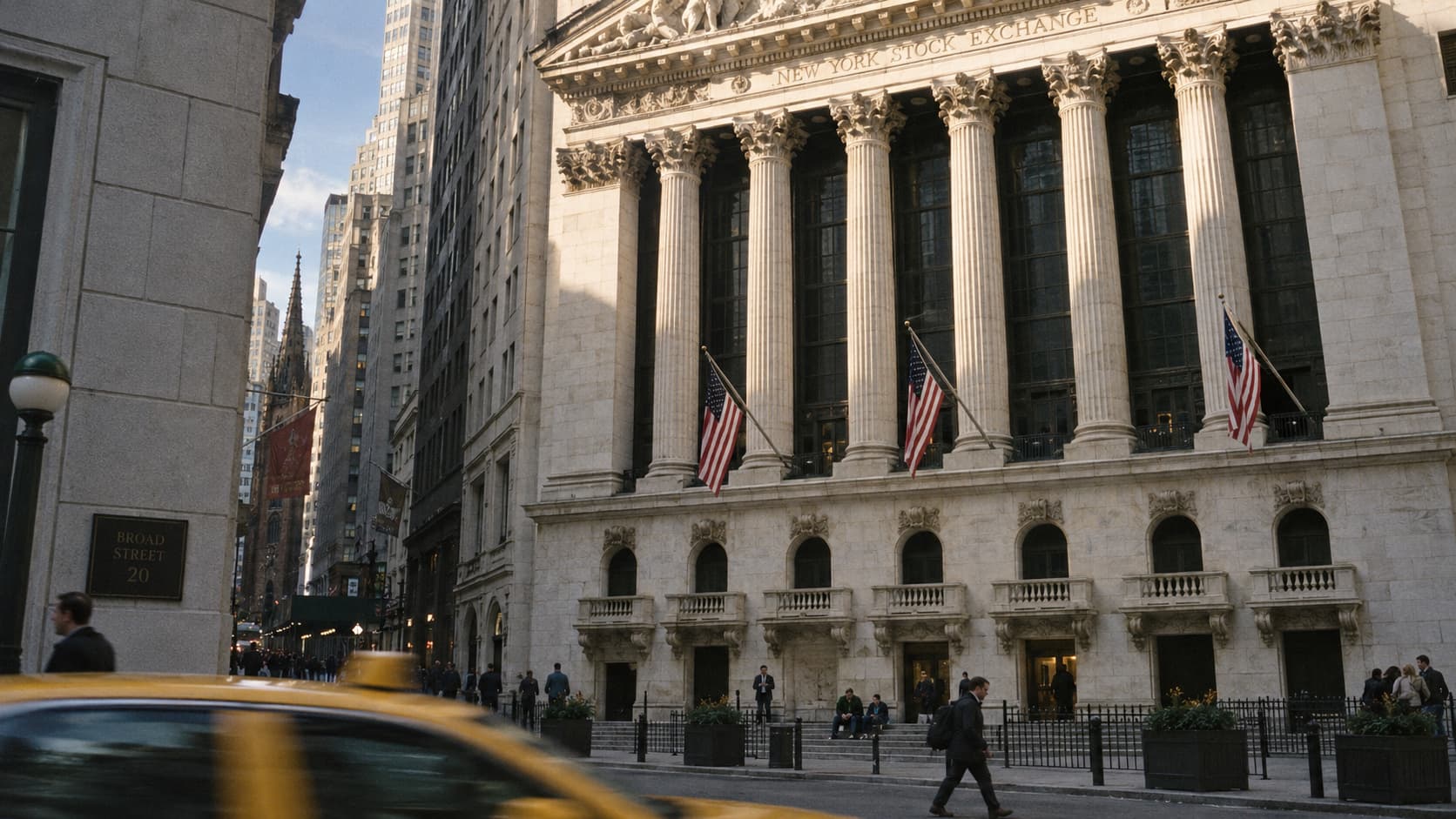
The building, when it comes, is put up by the intermediaries, and it is put up to protect them. On 17 May 1792, twenty-four New York brokers signed that single sentence under a buttonwood tree on Wall Street. It is the founding document of the New York Stock Exchange, and it is a price-fixing agreement. What made the Exchange something more than a cartel came later, and it came from the companies. In 1853 the Exchange began requiring listed companies to provide complete statements of their shares outstanding and capital; in 1899 it required regular financial statements from every listed company; in 1910 it abolished the Unlisted Department through which shares had traded before a company qualified. The venue set the terms, the company met them, and in return its shares traded in one place at one price. A listing has been a partnership between the venue and the company for a hundred and seventy years.
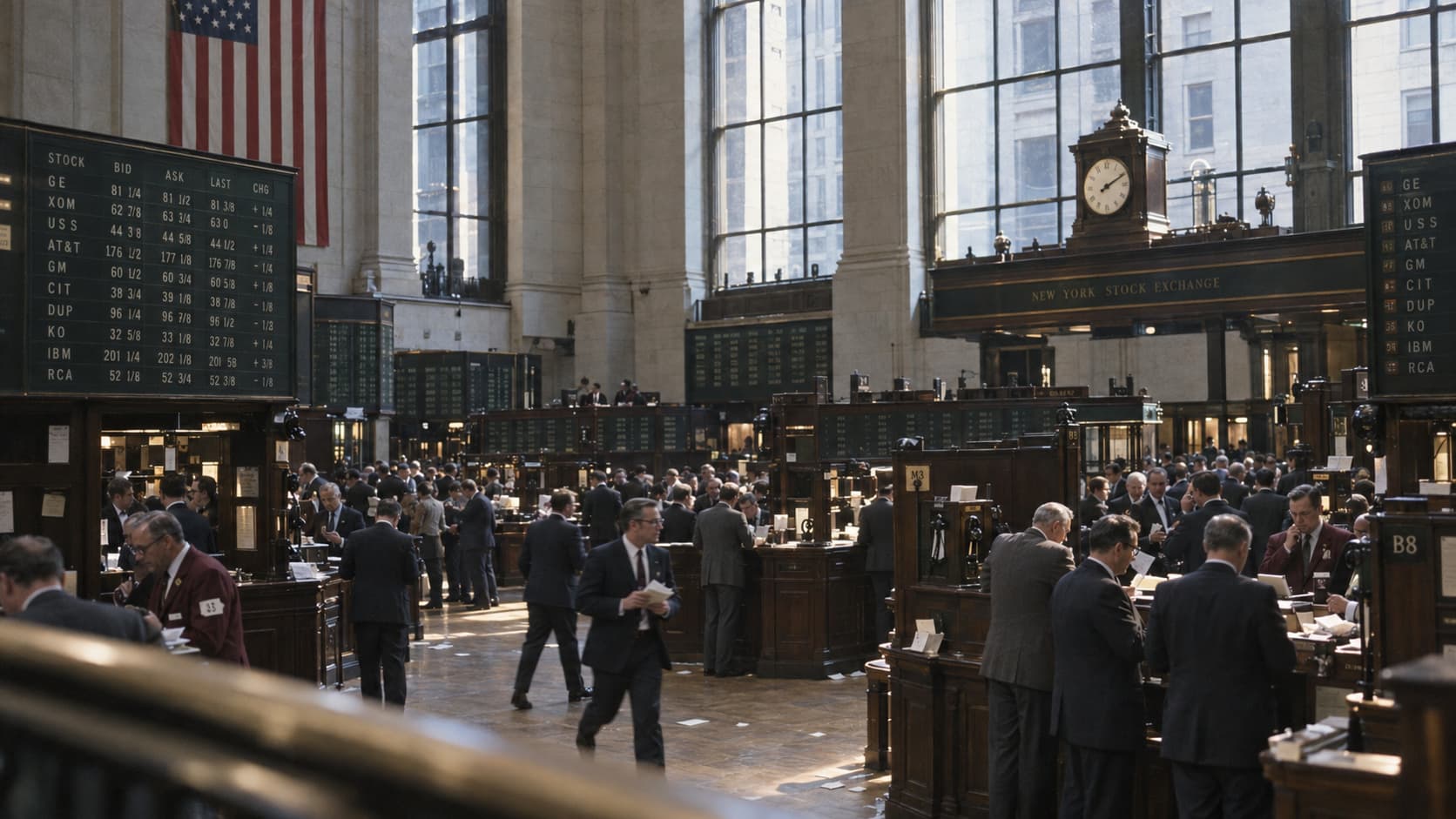
The floor, New York
Chicago showed what a standard does. The city became the center of the American grain trade in the 1840s, and the Board of Trade was founded in 1848 into a market of “repeated gluts and shortages, and chaotic price fluctuations,” where every lot had to be inspected and priced on its own. The Board's contribution was to make grain interchangeable: graded, warehoused, and from 1865 traded in standardized futures contracts. Once a bushel of No. 2 spring wheat was the same bushel in every contract, a price for it could exist. Amsterdam's transferable share had done this for ownership; Chicago's grade did it for goods. Every market that has ever consolidated has needed a unit that means the same thing to both sides.
There has also always been a street outside the building. From the 1860s the stocks the New York Stock Exchange would not list traded on the Broad Street sidewalk, in a stretch traders called the gorge, among “curbstone brokers” who took their orders from clerks leaning out of the office windows above. Each firm had its own hand signals, and its boys wore distinctive caps so the clerks could find them in the crowd. The companies on the Curb were the ones the Big Board considered too young or too speculative, and the list of them reads like a history of the twentieth century: Coca-Cola, General Motors, Standard Oil, Shell and Philip Morris all traded on the sidewalk before they qualified for the floor. About 80 percent of the orders on the Curb came from New York Stock Exchange member firms, which is to say the incumbents fed the market they would not host. When the curbstone brokers finally organized, in 1908, they named their body the Curb Agency and declared that it had “NO ORGANIZATION WHATEVER,” to keep it out of anyone's reach. They moved indoors on 27 June 1921 and in time became the American Stock Exchange. The market for unlisted companies had existed for sixty years before it had a roof, and the best companies in it applied for a listing and moved on.
The street also had bucket shops. From the 1870s, storefronts across America let anyone with a dollar “buy” stocks on margins as high as 100 to 1, with no shares ever changing hands; the customer was betting against the house on the next number to come over the ticker, and the house, which could see all the orders, front-ran and manipulated at will. The Supreme Court in 1906 defined the bucket shop as a place “nominally for the transaction of a stock exchange business” but “really for the registration of bets.” For the first time ordinary people could take part in the market, and they did so through an instrument that tracked the price of a share without conferring any part of one. The New York Stock Exchange's first response, in 1889, was to cut the bucket shops off from its ticker. The embargo hurt the Exchange's own members more than the bucket shops and was abandoned within days. What ended them was New York's Martin Act in 1921, a fraud statute, together with a regulated market that, by then, was cheaper and safer to use than the bet.
Fragmentation also ran along the map. In the nineteenth century an American company's shares traded where the company was, because that was where the information was: Philadelphia, Boston, Baltimore, Charleston and New Orleans all had exchanges before the Civil War, and Pittsburgh, Chicago, San Francisco, Cincinnati, Cleveland, Los Angeles, St. Louis and Detroit added theirs by 1907. Detroit traded automobiles, Los Angeles oil, San Francisco mines. The regionals also listed the companies New York rejected, on lighter disclosure. In 1934, when exchanges first had to register with the new Securities and Exchange Commission, twenty-four did and nineteen more were temporarily exempted: forty-three venues for one country's stocks. The telegraph and the ticker had already made a New York price visible everywhere; the 1934 Act imposed uniform listing standards, which removed the regionals' main reason to exist; Chicago, Cleveland and St. Louis merged into the Midwest Stock Exchange in 1949, and San Francisco and Los Angeles merged in 1953. Each step was the same step. As soon as everyone could see the same information, the reason to trade in forty-three places disappeared.
The largest fragmented market of all was never on an exchange. Thousands of American stocks traded over the counter, priced by telephone between dealers whose quotes were collected in a daily booklet, the pink sheets, printed since 1913. A 1963 study by the Securities and Exchange Commission laid out the opacity of that market, and the dealers' association answered it with a screen. On 8 February 1971 the National Association of Securities Dealers Automated Quotations system went live, built under contract by Bunker Ramo, a maker of military electronics, and for the first time a dealer in Denver and a dealer in New York could see the same quote at the same moment. The over-the-counter market was given a screen and became Nasdaq, which today lists the largest companies on earth. Congress followed in 1975 with a mandate for a national market system, and the regional exchanges never recovered from the combination.
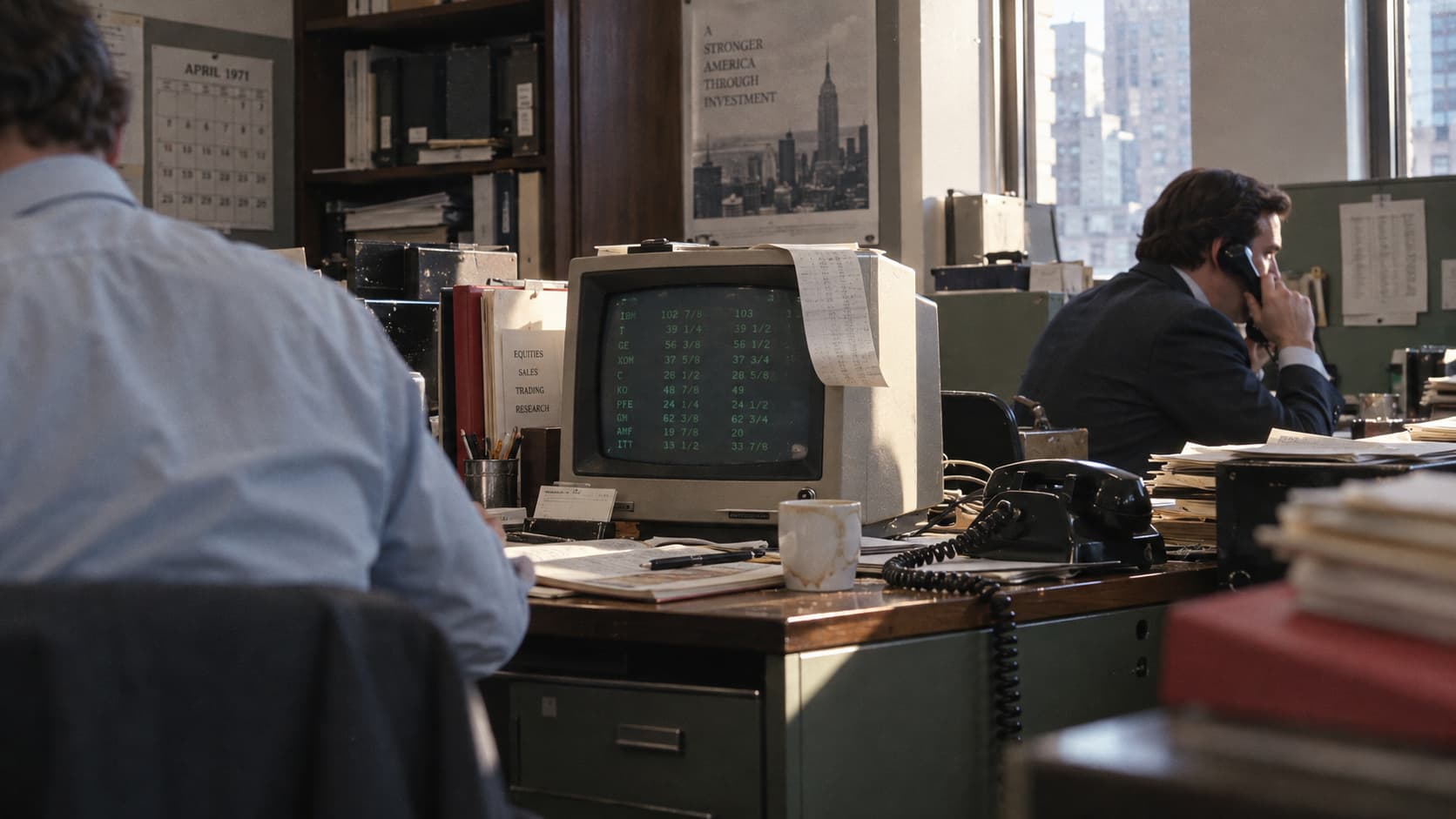
The dealing room, 1971
GPT Image 2
The cleanest experiment came last, in a market that had resisted every previous consolidation. American corporate bonds traded over the counter, dealer to dealer, with no public record of prices, for the whole of the twentieth century. In July 2002 the regulator began requiring dealers to report their trades to a system called TRACE and disseminating the prices to the public. The dealers had argued that transparency would come at the cost of liquidity, and in the least liquid bonds trading activity did fall, by about 41 percent on one estimate. For the bonds whose prices were published, the cost of trading fell by roughly half, and execution costs fell by a fifth even for bonds that were not yet covered, because a published price for one bond tells you what its neighbors should cost. Dealer employment and compensation fell; the largest dealers lost market share. Nothing in the structure of the market had changed except that the price was public.
Corporate bond trading before and after prices were published, 2002 to 2006
Half the cost, gone at the flip of a switch, with no new technology and no new participants. A number became public, and that was all. The spread between what buyers and sellers see is the intermediary's income, and it survives exactly as long as the dark does.
The private market for the most valuable companies of our era runs at five to eighteen percent access cost, two orders of magnitude above anything on this chart. A startup is no harder to price than a junk bond. Nobody has switched the light on yet.
That is the whole history, and it has one shape. A market forms wherever value and demand meet, before anyone gives permission and long before anyone builds a venue: a bridge in Amsterdam, a coffee house in London, a sidewalk in New York, a telephone line between two dealers. In that state it is expensive. Prices differ from one corner to the next, the spread between them is the intermediary's income, information is the only real asset, and the people who pay most for the absence of rules are the smallest participants, the ones in the bucket shops. Then, in every case, the same three things arrive: a unit that means the same thing to both sides, a venue where that unit trades in one place, and a published price. When they arrive together the spread collapses, participation grows by an order of magnitude, and the market becomes an engine of prosperity for the companies in it. And in every case the transition was made with the companies, whose consent and whose disclosure were the price of admission: the VOC's bookkeeper, the Exchange's financial statements, the Curb's best companies applying for the floor. The shadow market is the signal that the real one is about to form.
The Retreat Into Private
On 15 May 1997 Amazon sold shares to the public at $18 each. It raised $54 million at a valuation of $438 million; it was three years old and had sold $16 million of books in the previous quarter. Everything that happened next, the climb from $438 million to more than two trillion dollars, happened in public, where anyone with a brokerage account could own a piece of it and the price was printed every morning. On 11 June 2026 SpaceX sold shares to the public at $135 each. It raised $75 billion, two and a half times the previous record, at a valuation of about $1.75 trillion; it was twenty-four years old. The public got SpaceX at four thousand times the size at which it got Amazon, and it got it at the end. OpenAI and Anthropic have filed to follow the same way.
Nothing in the nature of rockets or language models required this. What changed between 1997 and 2026 was a set of rules, each of them reasonable when written, that together moved the growth of the era's defining companies out of the public market and into a legal structure with no market in it. Three rules did most of the work, and one assumption held them together.
01
A wealth test that stopped testing wealth.
The first rule is the oldest. In 1982 the Securities and Exchange Commission adopted Regulation D, which let companies raise money privately, without registering, from “accredited investors”: people with a net worth of a million dollars or an income of $200,000. The idea was to fence off private offerings for people who could bear the risk, in a world where a company's private phase lasted a few years and involved a few dozen holders. The thresholds have never been adjusted. In 1983 about 1.5 million American households qualified, 1.8 percent; by 2022, through inflation alone, 24.3 million did, 18.5 percent. Had the thresholds kept pace with prices, the net-worth test would stand at just over three million dollars and 6.5 percent of households would pass it. The rule has become a wealth test that fails as a wealth test, and it has never been a test of anything else.
- 1 1983, 1.5M households
- 2 2022, 24.3M households
- 3 2022, thresholds indexed to 1982
Households that pass the accredited-investor test, 1983 and 2022
- 1 1983, 1.5M households
- 2 2022, 24.3M households
- 3 2022, thresholds indexed to 1982
02
The forcing function, raised out of reach.
The second rule was the forcing function, and it has been removed. Since 1964, a company with more than 500 holders of record had to register with the Commission and report like a public one. That threshold is what pushed Google into its 2004 offering and Facebook into its 2012 one: enough employees and early investors held shares that the company had to become public whether it wished to or not. In April 2012, six weeks before Facebook listed, Congress passed the JOBS Act, raised the threshold to 2,000 holders, and excluded employees from the count altogether. The last rule that forced a company into the public market was raised out of reach in the same year it last fired.
- 1 Peak, 677 offerings, 1996
- 2 Sarbanes-Oxley, 2002
- 3 JOBS Act, 2012
US initial public offerings per year, 1980 to 2025
- 1 Peak, 677 offerings, 1996
- 2 Sarbanes-Oxley, 2002
- 3 JOBS Act, 2012
03
Public got expensive, private got cheap.
The third change came from the other side. The Sarbanes-Oxley Act of 2002 raised the cost of being public, and from about 2010 the capital that had once required an IPO stopped requiring one. SoftBank launched a $100 billion fund in 2017 to invest in private companies; crossover funds, sovereign funds and mutual funds followed. A company that could raise a billion dollars privately in a single round had no reason to accept the disclosure, the litigation and the quarterly scrutiny that came with raising it publicly.
- 1 Five years, 1999
- 2 Fourteen years, 2024
- 3 Period medians, 1980 to 2025
Median age of a company at its IPO, in years, 1980 to 2025
- 1 Five years, 1999
- 2 Fourteen years, 2024
- 3 Period medians, 1980 to 2025
Listed US companies against unicorns waiting to list, 1996 to 2024
The two lines are one story, and the numbers describe it. Between 1990 and 1998 the United States averaged about 400 initial public offerings a year; in 1996 there were 677. Between 2001 and 2025 it averaged about 113, and in 2025 there were 90. The median company going public in 1999 was five years old; in 2025 it was twelve. The count of listed American companies fell from more than 8,000 in 1996 to about 4,700 in 2024, while the queue for the venue grew: by one count 1,242 private companies worth more than a billion dollars were waiting to list, 954 of them in North America, and the average one had been private for nine years.
The turn has a date. After the JOBS Act of 2012, staying private stopped being a phase and became a strategy, and the growth phase of the American company, the years in which most of its value is created, moved from a market with a published price to a structure with none.
04
Rules written for a waiting room.
Every one of these rules rested on the same assumption: that the private phase would be short, small and closed, a few dozen holders for a few years, after which the public market would take over. The assumption held for Amazon. It stopped holding somewhere between Google and Facebook, and when it broke, Congress adjusted the rules to accommodate the break.
The private company became the permanent home of the American growth story, governed by rules written for a waiting room.
Five Things Followed
01
Price by negotiation.
A private company's value is set when it raises money: once, by one lead investor, in one negotiation, for one class of shares. By the end of 2024 the median gap between a seed round and a Series A had reached 774 days, and between a Series A and a Series B 732 days, roughly double what it had been three years earlier. For two years at a time there is no price. There is an appraisal of the common stock, produced for tax purposes by a valuation firm, and there are rumors. De la Vega's shareholder would recognize the arrangement.
02
Transfer restrictions as the entire rulebook.
The private company's market structure consists of prohibitions: a right of first refusal, a board consent, and now a clause declaring unapproved transfers void. There is no venue behind any of them, so the rules govern who may leave and say nothing about how. The people who bear this are the ones who built the company. When employees leave, most of their vested options go unexercised; in 2020 the share exercised fell below 30 percent. They forfeit their part of the company because there is no way to learn what it is worth and no way to sell enough of it to pay the tax on the rest.
03
Intermediaries paid on opacity.
Where there is no venue, someone has to find the other side of every trade, and they charge for it: access fees that run from under five percent to as much as eighteen, and a management fee and a share of profits at every layer of every vehicle. A three-layer vehicle that turns $2 million into $10 million hands nearly $5 million of the gain to the layers. One platform alone has collected roughly $200 million in fees for forming such vehicles. The layers exist because the venue does not.
04
The cap table as the product.
The infrastructure private companies did build manages ownership: who holds what, vesting, dilution, the appraisal. It records ownership; hosting a market for it was never its job. The companies at the very top have begun to build the market by hand, one tender offer at a time, and the pace shows how much demand there is: among the issuers on one venue the average gap between tenders fell from 899 days in 2022 to 132 in 2025, and in 2025 tender offers on that venue moved $35 billion against $45 billion raised in all American IPOs. The most sanctioned form of private liquidity is now close to the size of the public one, and each tender is built from scratch.
05
Failure without consequence.
A platform that managed more than $500 million for retail investors is in bankruptcy. Three New York brokers pleaded guilty this January to raising $185 million from more than a thousand investors for vehicles they had misrepresented. A fund manager received four years in prison for selling allocations in Anduril he never had. The bucket shops ran on the same material and were shut down for it. These ended with a bankruptcy filing and a sentence, and the structure that produced them did not change.
This is the private market in 2026. It is Amsterdam before the exchange building, the Curb before it moved indoors, the bond market before anyone published a trade. The rules written in 1982 to keep the public out of a short, closed phase now keep it out of the longest and most valuable phase in a company's life, and the public has come in anyway, through tokens and stacked vehicles, the way it once came in through the bucket shops. The 24 million households the rule admits mostly cannot find the door; the ones it excludes have found the wrong one. And the company, whose consent is now the only thing that makes any of it legitimate, has nowhere to bring it.
The Private Market Today
01
Venues built around the company.
EquityZen, the private-share marketplace Morgan Stanley bought this year, completed 49,000 transactions in its first twelve years, across 450 companies, for 800,000 registered users. That is about eleven trades a day. Forge, the largest independent venue until Charles Schwab bought it in November 2025 for $660 million, had matched $17 billion of private shares in its entire existence. In 2025 alone, tender offers run by companies on a single venue moved $35 billion. The market that forms around the company, for all its brokers and platforms and vehicles, is small next to the market that forms with the company, even in the crude form the tender offer gives it: one window every few months, built from scratch each time.
That is the structure of the private market today, and it explains most of what happens in it. On one side are the venues: marketplaces that match a seller who wants out with a buyer who wants in, and brokers who do the same by telephone. They do real work. Every trade in this market has to be found, priced, papered, approved by the company under its right of first refusal, and recorded by a transfer agent, and the venues have built order books, indicative price series and settlement teams to do it. But each trade is still a bilateral negotiation about a specific block of a specific share class, and the venue's product is access to a company that did not ask to be accessed. The company is a counterparty in the process, with a thirty to sixty day window to block the sale, and the venue's job is to get past it.
- 1 Tender offers on one venue, 2025
- 2 Proceeds of every US IPO, 2025
- 3 Forge, all private shares matched since 2014
Dollars moved: company tenders, the public market and the largest independent venue
- 1 Tender offers on one venue, 2025
- 2 Proceeds of every US IPO, 2025
- 3 Forge, all private shares matched since 2014
02
Vehicles, four and five deep.
On the other side are the vehicles. Because a direct transfer needs the company's approval and a vehicle does not, the special-purpose vehicle became the industry's main product: a fund that holds the shares, sold in pieces to investors who hold the fund. Sydecar, which administers such vehicles, went from $3.5 billion to $5.5 billion under administration in six months. Augment, a marketplace for them, grew from under $200 million to over $1 billion in twelve months and projects its revenue rising from $12 million in 2025 to $100 million in 2027. When Anthropic published its list, Hiive alone held 44 separate vehicles named after Anthropic, with more than $150 million of Anthropic shares inside them. Hiive's chief executive estimates that vehicles of this kind hold hundreds of billions of dollars of private companies. Forty-four vehicles for one company means forty-four prices, forty-four fee schedules and forty-four managers between the investor and the share, and each vehicle can itself be sold in pieces, which is how the stacks four and five deep in SpaceX came to exist.
- 1 Taken by three layers of two-and-twenty
- 2 Kept by the investor
- 3 Venue fee, one to two percent, once
What reaches the investor from a $2M to $10M outcome
- 1 Taken by three layers of two-and-twenty
- 2 Kept by the investor
- 3 Venue fee, one to two percent, once
03
One share, many prices.
The price is what you would expect from such a structure. In February 2025, the same Cerebras share was quoted at $13 by one venue's lowest institutional bid and $57 by another's highest listing, and the second venue alone showed a range from $39 to $57 depending on the deal type. The reasons are the reasons a bond trader in 2001 would have given. A vehicle's fees push its effective price up; a large block sells at a discount and a small retail piece at a premium; a Series F preferred share with senior liquidation rights is worth more than a Series A share of the same company; a seller who needs cash this month takes what is offered. Each venue publishes an indicative price built from the fragments it can see, because none of them can publish a trade for the whole market. The public bond market ran on the same estimates until 2002.
- 1 Venue A, lowest institutional bid
- 2 Venue B, low end by deal type
- 3 Venue B, highest listing
The same Cerebras share, quoted on two venues, February 2025
- 1 Venue A, lowest institutional bid
- 2 Venue B, low end by deal type
- 3 Venue B, highest listing
04
Weeks to settle, when it settles at all.
Then there is time. A right of first refusal runs thirty to sixty days. A transfer that survives it still has to be approved, papered and recorded. A public share settles the next day; a private one settles in weeks when it settles at all.
05
Prohibition, and what it changed.
The companies have answered all of this with prohibition. OpenAI and Anthropic declared unauthorized transfers void; Anthropic named the venues it would not recognize; SpaceX removed vehicle investors from its cap table before it listed. The market's answer was to reprice and continue. A token tracking Anthropic lost a third of its value in a day, and the vehicles kept forming, because the demand behind them had not changed and no legitimate route had opened. Prohibition changed the price of the shadow market and left its existence untouched.
06
The incumbents consolidate.
Meanwhile the incumbents consolidated. Morgan Stanley announced its purchase of EquityZen on 29 October 2025, citing a market in which “companies stay private longer.” Eight days later Schwab announced Forge, and its chief executive explained what a marketplace was worth to a firm with “46 million client accounts and $11.6 trillion in client assets.” The two largest independent venues became distribution arms of wealth managers within a fortnight of each other, and the remaining independents, Hiive and Nasdaq Private Market among them, now occupy a different position in a divided industry. There is an integrity question in this that observers raised at the time: a venue inside an institution that also advises companies, manages the assets of their investors and keeps its own commercial relationships with them has more interests to balance than a venue alone. It is a fair question, and it is smaller than the one it obscures: the banks bought distribution, because there was no market to buy.
The venues, the vehicle sponsors and the banks are doing what a market with no rails rewards, and doing much of it well. Their margin is the spread and the layers, and they cannot be expected to build the thing that would remove it. Every venue in the private market is built around the company, and the market is still waiting for one built with it.
The Company Is the Missing Piece
The last three years have settled four questions that used to be open.
01
Who decides whether a market is legitimate.
In 1910 the New York Stock Exchange closed its Unlisted Department and the Curb went on trading the same shares on the sidewalk, because nothing the Exchange said could reach a transaction between two brokers on Broad Street. In May 2026 two companies changed a paragraph in their transfer policies and a token that tracked one of them lost a third of its value before the next morning. The company's consent has become the scarce input to any market in its shares. It always was the price of a listing; the VOC's bookkeeper and the Exchange's 1899 rule were both about consent. What is new is that consent now has a price of its own, visible in a single day's chart, and that the company holds all of it.
02
Whether the demand is real.
Polymarket's traders put the odds of an OpenAI listing in 2026 at about 72 percent this spring, on a market that reprices every minute. On the venue that runs company tender offers, 60 percent of the programs in 2025 were oversubscribed, and in four of every ten of those the orders exceeded twice the offering. Robinhood's chief executive said that after his token announcement, private companies were asking to join. Charles Schwab paid $660 million for Forge and said the words “46 million client accounts” in the press release. Nobody needs to argue that there is a public for private companies. Two of the largest wealth managers in the world have just paid for the door.
03
Whether companies will form their own markets.
They already do, by hand. Thirty-one companies settled tender offers on one venue in 2025, up from twelve the year before, and the average gap between a company's tenders fell from 899 days in 2022 to 132. Nearly half of those programs were run by companies between seed and Series C, up from 30 percent two years earlier. A tender offer is a company forming its market with its own consent, on its own calendar, with its own disclosure, once every four months, and rebuilding the whole apparatus each time. It is an exchange run by email.
04
Whether the pieces exist.
They do, in the way the pieces of Nasdaq existed in 1970: the dealers, the telephones, the daily sheets of quotes were all there, and what was missing was the screen that put them in one place. The order book exists, in the venues. The transfer agent and the cap table exist as software with interfaces. The tender offer has an administration industry. The exemptions under which a company can sell to the public in stages have been on the books since 2012 and 2015. Settlement can be electronic. Nobody has assembled these around the one thing that makes any of them legitimate, which is the company's consent.
Put the four together and the shape of the missing piece is plain. It is a venue on which a private company lists, in the sense the word has carried since 1853: the company applies, agrees to the venue's rules on who may participate and in what structure, discloses on the venue's schedule, and in return its shares trade in one place, in windows the company opens, at one price per window, for a fee of one or two percent of each trade. The participants hold one instrument in one layer. The company's operating cap table stays what it was. And the venue exists before the synthetic market does, so that the LinkedIn message and the token arrive to find the official route already open.
Every venue built so far routes around the company. The missing one starts from the company's consent. The company of 2026 has the consent power of a listing and no exchange to list on.
06
A company's market is formed with the company, in windows, on a venue built before the shadow market arrives.
A New Model
The debate about private companies assumes a choice between two conditions. A company can stay private, which means opaque, restricted and priced by negotiation, or it can go public, which means the disclosure regime of a mature corporation, quarterly scrutiny and the litigation that comes with it. The history in Section 2 shows the choice is false.
From 1602 to 1910 the world built a third condition, the listing, and then over thirty years the American company stopped using it during the phase of its life in which it creates most of its value. The new model restores the listing to that phase, in the form the private stage can use: a market of windows. It has five principles.
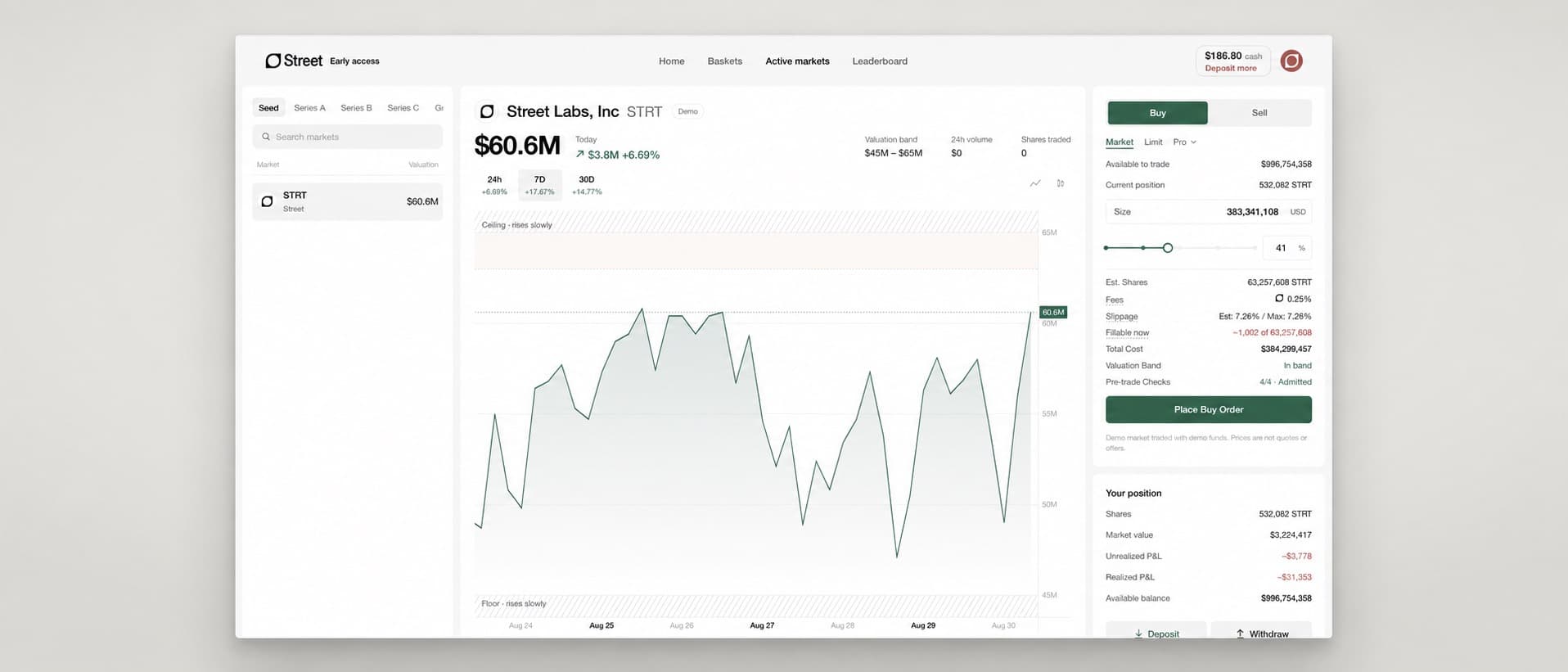
The window
Street, demo market
The listing comes first.
The market for a company is formed with the company, the way every listing has been. The company applies; the venue sets the rules, on who may participate, in what structure, with what disclosure, and when; the company consents and discloses; the venue runs the windows and clears the price in each of them. In practice this means a listing agreement for a private company, and a transfer policy that contains a route as well as a prohibition: transfers outside the venue are void, transfers on it are pre-approved. The right of first refusal, the board consent and the void clause are all preserved. They are exercised once, at listing, and from then on the venue's rules apply to every trade.
One layer, one price.
Every participant holds the same instrument in the same vehicle, and there is no vehicle on top of the vehicle. Within a window every trade clears in one venue under one set of rules, and the window produces a print: one number for the company, in place of the forty-four prices the vehicles produce today. One layer removes the stacked fees, and what replaces them is a venue fee of one to two percent of each trade, paid once. On the three-layer example in Section 2, an investor who put in $2 million and took out $10 million would pay between $120,000 and $240,000 in total on the venue, against nearly $5 million through the layers.
Structure before liquidity.
A market for a company's shares does not mean a thousand strangers on its cap table. The operating cap table stays as it was: founders, employees, the funds. Beside it sits a participation layer, a single vehicle that holds the market's shares and appears on the cap table as one line, governed by rails the venue administers on the company's behalf: voting, information rights, transfer, and the terms under which the layer converts or rolls into a public listing. The founder's fear about liquidity is a fear about structure, and the answer is a structure, agreed before the first trade.
The company owns the narrative of every print.
A price without facts is a rumor with a decimal point, and today the number reaches the world through a broker's message or a token's chart. In the new model the company decides what is said about its print, to whom, and how far it travels: to employees, to existing investors, to the next lead, to the press. The price is formed by the participants in the window, and every participant sees it, which is what a published price meant in every market in Section 2: the people admitted to the market saw the same number. The story around it belongs to the company. The venue's rule on disclosure is simple: what the company tells its lead investor, it tells the window's participants, on the venue's schedule, in one voice, and the people closest to the company, the users and employees the brokers were already messaging, become its first and best-informed participants. Consistency inside the window is the disclosure regime of the private stage. Narrative control outside it is what the company gets for opening the window.
Windows, on the company's calendar, at every stage.
The window is the instrument of the private stage; the ticker belongs to the public one. The market opens when the company opens it, on a cadence the company sets, the way the largest companies have already arrived at by hand, and the venue keeps the apparatus between windows so that the second one costs a fraction of the first. It scales down to the seed stage, where nearly half of the sanctioned programs already are. And the first window opens before the shadow market forms. The Curb, the bucket shops and the tokens all teach the same thing: demand for a company's shares will be served by someone, and the only decision the company gets to make is whether the first venue is its own.
The Two Markets, Side by Side
01
Price
TodaySet once per round, by one negotiation; rumors in between
The new modelOne print per window, formed with the company
02
Narrative
TodayA broker's message, a token's chart
The new modelThe company's, around every print
03
Rulebook
TodayProhibitions: ROFR, board consent, void clauses
The new modelA listing: rules agreed once, transfers on the venue pre-approved
04
Vehicle
TodayVehicles on vehicles, four and five deep
The new modelOne participation layer, one line on the cap table
05
Fees
Today5 to 18 percent access, plus two-and-twenty per layer
The new model1 to 2 percent per trade, once
06
Disclosure
TodayThe last lead's deck
The new modelWhat the lead was told, told to the window's participants
07
Participants
TodayWhoever a broker found
The new modelUsers, employees and investors the company admitted
08
Timing
TodayWhen a seller is desperate or a broker persistent
The new modelWindows on the company's calendar, from seed
09
The company
TodayA counterparty to get past
The new modelThe party that lists
The largest companies already do this, at great effort, every 132 days. Investors oversubscribe nearly every window they open. The structure itself is four hundred years old. We are building the venue described here, and this document is the standard we intend to be held to.
06
Bring the Market Indoors
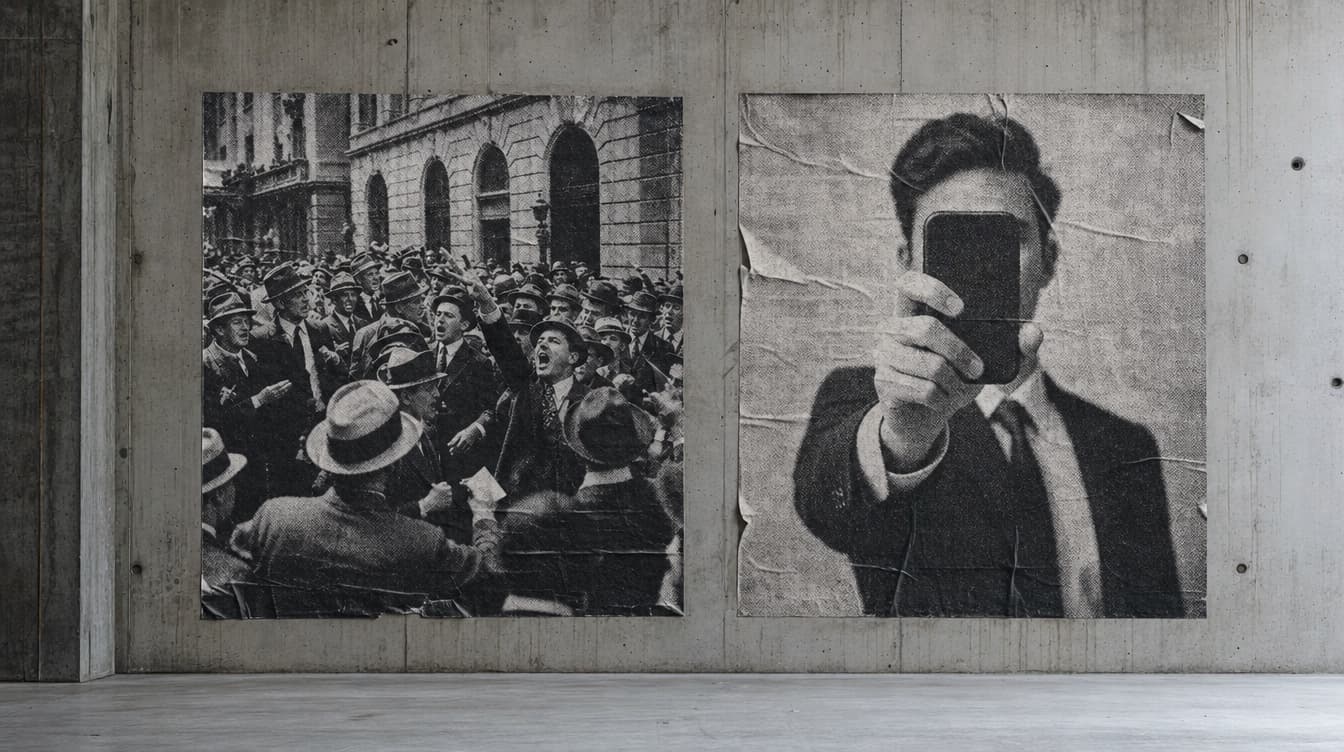
The Curb moved indoors in 1921. The private market is still on the sidewalk.
If you have read this far, you build, fund or work at a company this market is forming around. A market formed with the company is the oldest structure in finance, and the only one that has not yet been built for this era.
Help us build it. List your company.
- 1. OpenAI, “Robinhood tokens are not OpenAI equity,” company newsroom statement, 2 July 2025.
- 2. Robinhood, Cannes presentation on tokenized private companies and the European Union giveaway, 30 June 2025; subsequent remarks by its chief executive on retail exposure and inbound interest from private companies.
- 3. OpenAI and Anthropic transfer policies as amended in May 2026, declaring unauthorized transfers, including through special-purpose vehicles, tokens and forward contracts, void; Anthropic’s published list of eight venues whose transactions it will not honor.
- 4. SpaceX initial public offering, 11 June 2026: $135 per share, about $75 billion raised at a valuation near $1.75 trillion, and the treatment of investors in stacked vehicles before listing.
- 5. Cerebras secondary quotes, February 2025: a $13 institutional bid on one venue against a $39 to $57 range on another, by deal type.
- 6. Jay R. Ritter, “Initial Public Offerings: Median Age of IPOs Through 2025,” Table 4, University of Florida, updated 24 December 2025.
- 7. World Bank and World Federation of Exchanges, listed domestic companies, United States, 1996 to 2024.
- 8. Aileen Lee, “Welcome to the Unicorn Club,” TechCrunch, 2 November 2013; CB Insights, unicorn counts through 2026.
- 9. Securities and Exchange Commission, “Review of the ‘Accredited Investor’ Definition Under the Dodd-Frank Act,” staff report, December 2023.
- 10. Jumpstart Our Business Startups Act, Pub. L. 112-106, 5 April 2012, Title V, raising the holder-of-record threshold from 500 to 2,000 and excluding employee holders.
- 11. Sarbanes-Oxley Act of 2002, Pub. L. 107-204.
- 12. Securities and Exchange Commission, Regulation D, adopted 1982, Rule 501 definition of accredited investor.
- 13. Carta, State of Private Markets, year-end 2024: median days between seed and Series A and between Series A and Series B; share of vested options exercised at departure, 2020.
- 14. Nasdaq Private Market, tender offer data, 2022 to 2025: companies settling tenders, average days between a company’s tenders, program oversubscription, and dollars moved.
- 15. Charles Schwab, announcement of the acquisition of Forge Global for about $660 million, 6 November 2025; Morgan Stanley, announcement of the acquisition of EquityZen, 29 October 2025.
- 16. Forge Global, acquisition of SharesPost, May 2020; Nasdaq, acquisition of SecondMarket, October 2015; Nasdaq Private Market spin-out with SVB, Citi, Goldman Sachs and Morgan Stanley, July 2021.
- 17. Hendrik Bessembinder and William Maxwell, “Markets: Transparency and the Corporate Bond Market,” Journal of Economic Perspectives, 2008; Amy Edwards, Lawrence Harris and Michael Piwowar, “Corporate Bond Market Transaction Costs and Transparency,” Journal of Finance, 2007; Paul Asquith, Thomas Covert and Parag Pathak, “The Effects of Mandatory Transparency in Financial Market Design,” NBER, 2013.
- 18. Charter of the Dutch East India Company, 20 March 1602, article on transfer through the bookkeeper of the chamber; subscription books of the six chambers, August 1602.
- 19. Joseph de la Vega, Confusión de Confusiones, Amsterdam, 1688.
- 20. Buttonwood Agreement, New York, 17 May 1792; New York Stock Exchange listing requirements of 1853, 1899 and the closing of the Unlisted Department, 1910.
- 21. Chicago Board of Trade, founded 1848; standardized futures contracts from 1865.
- 22. Robert Sobel, The Curbstone Brokers: The Origins of the American Stock Exchange, 1970; Curb Agency, 1908; move indoors, 27 June 1921.
- 23. Board of Trade of the City of Chicago v. Christie Grain & Stock Co., 198 U.S. 236 (1905), and Gatewood v. North Carolina, 203 U.S. 531 (1906), on bucket shops; New York Martin Act, 1921.
- 24. Securities and Exchange Commission, Special Study of Securities Markets, 1963; NASDAQ launch, 8 February 1971, built by Bunker Ramo; Securities Acts Amendments of 1975.
- 25. Amazon.com initial public offering, 15 May 1997: $18 per share, $54 million raised at a $438 million valuation.